Research
Satellite Surface Charging
Simulation-Based LEO Spacecraft Charging Risk Assessment
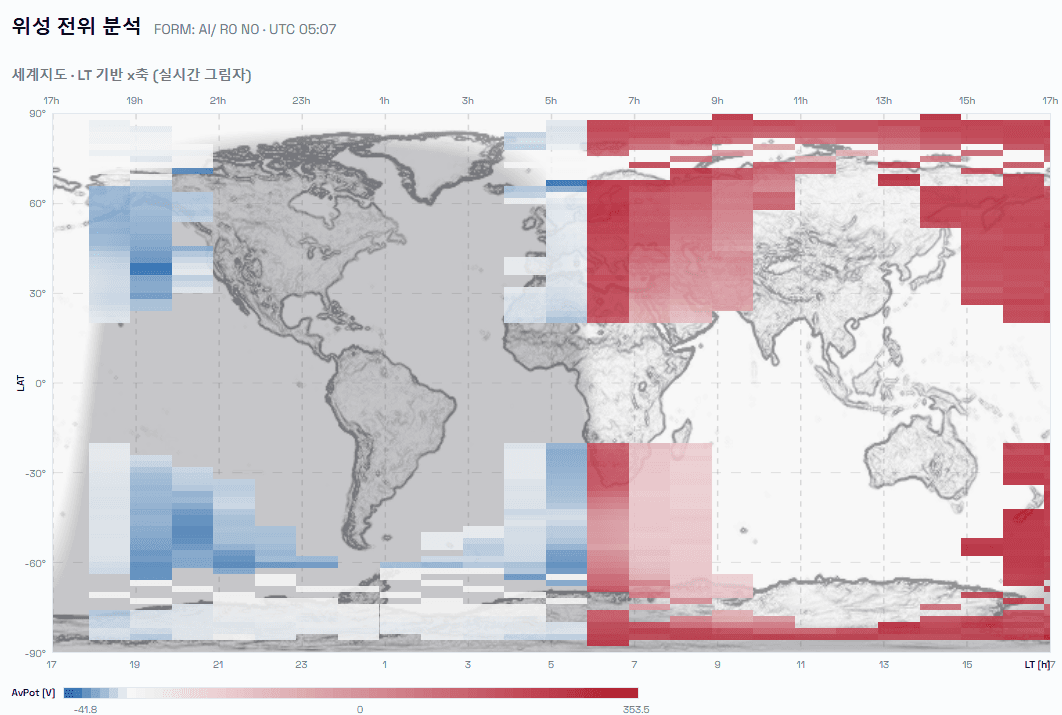
We develop a Spacecraft Plasma Interaction Software(SPIS)-based simulation pipeline to quantify electrostatic charging of LEO satellite constellations under varying space plasma conditions and to convert charging hazards into an multi-level charging risk index.
Space environment disturbances can trigger satellite anomalies through multiple mechanisms, including radiation effects and plasma–spacecraft interactions. Among them, electrostatic charging and electrostatic discharge (ESD) in low Earth orbit (LEO) is an increasingly pmractical risk because the number of commercial satellites and large constellations in LEO is rapidly growing. This project aims to understand how spacecraft charging levels change with satellite materials, structural configuration, and attitude/illumination conditions (day–night/eclipses). We will quantify both absolute surface potentials and differential charging that may lead to ESD-triggering electric fields. Based on systematic parametric simulations, we will classify charging hazards into discrete risk levels and establish a charging risk classification framework that can support mission design and operational assessment.
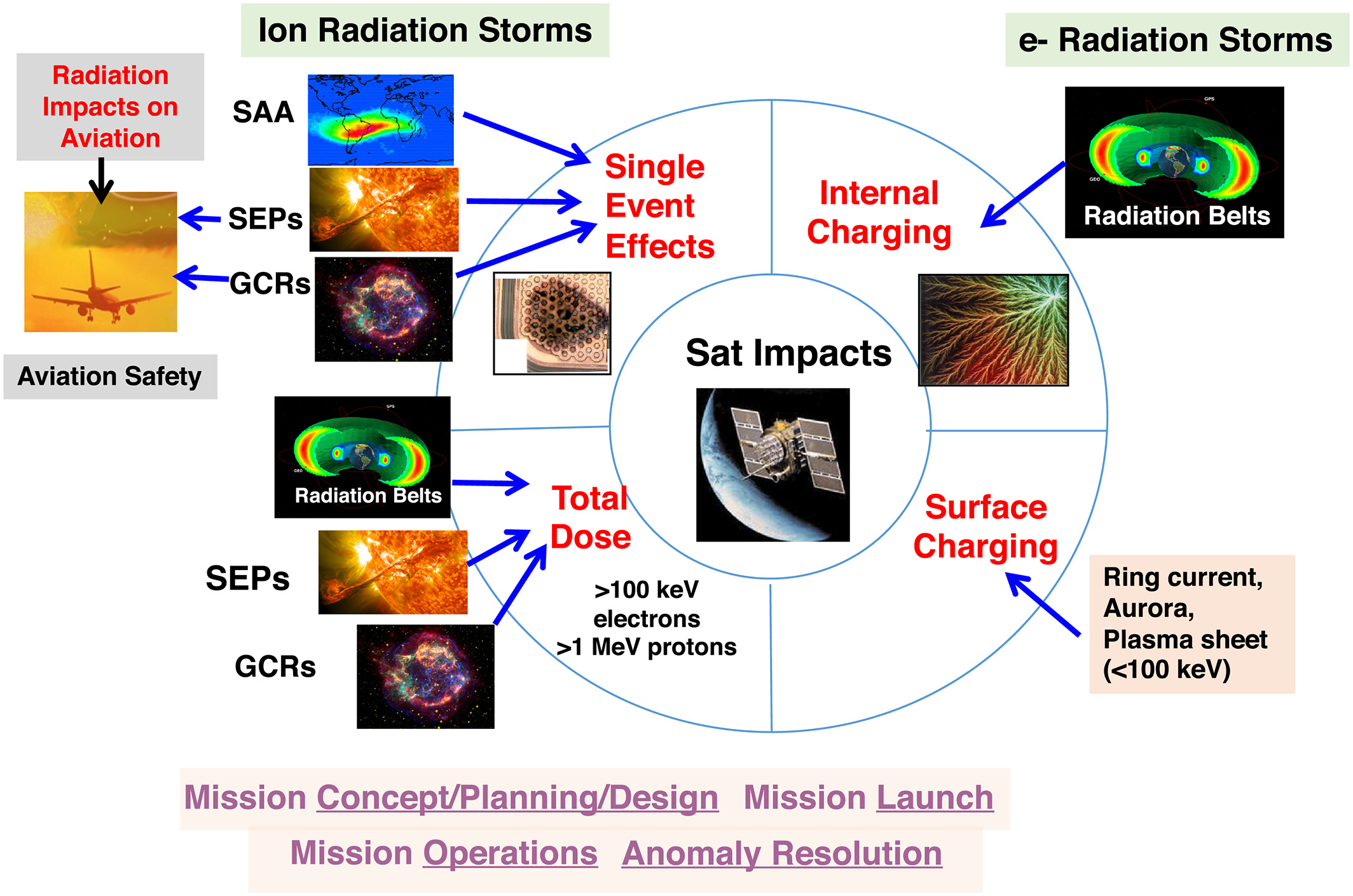
Fig.1 Summary of space weather impacts on satellites and their environmental sources.
Source: Reproduced from Zheng, Y., Ganushkina, N. Y., Jiggens, P., Jun, I., Meier, M., Minow, J. I., et al. (2019), “Space Radiation and Plasma Effects on Satellites and Aviation: Quantities and Metrics for Tracking Performance of Space Weather Environment Models,” Space Weather, 17(10), 1384–1403, Figure 1. doi:10.1029/2018SW002042. © 2019 The Authors. Used under the Creative Commons Attribution License.
SSIL leads the development of a numerical analysis workflow for LEO spacecraft charging using the SPIS. We build representative spacecraft geometries (including multi-material surfaces and electrically connected/isolated parts) and define LEO plasma scenarios to reproduce day/night charging environments. SSIL performs parametric simulation campaigns to evaluate how charging depends on surface material properties (e.g., conductivity and electron/photon emission characteristics), satellite configuration, and illumination conditions. Also, we are developing a GUI that allows users to easily view post-processed outputs such as node-level (component-wise) potentials, inter-component differential potentials, and hotspots in the surface potential distribution. Finally, SSIL translates simulation outputs into a practical multi-level charging risk index that can be used for risk assessment and mitigation guidelines.
We use SPIS, a well-established spacecraft–plasma interaction simulator, to compute self-consistent surface charging driven by ambient plasma currents and emission processes. The simulation framework is designed to run controlled parameters so that the impact of material choices, electrical connectivity, geometry, and illumination can be isolated and quantified.

Fig.2 SPIS simulation interface showing spacecraft charging analysis, monitoring the time evolution of node-averaged surface potential during the run.
This study uses SPIS to compute the spacecraft surface charging state formed by the current balance between ambient plasma currents and surface emission currents (e.g., electron and photoelectron emissions). To ensure comparable results, we define representative LEO plasma conditions (e.g., density and temperature) and illumination states (sunlit versus eclipse/night), and organize operational factors such as attitude variation and electrical connection/isolation strategies into simulation cases. We then build a 3D spacecraft geometry in SPIS, assign diverse surface materials (conductors, dielectrics, and coatings), and design the model to evaluate inter-component differential charging by specifying grounding/bonding conditions and node definitions. Based on this setup, we perform parameter-sweep simulations that systematically vary material combinations, structural/configuration options, and day–night conditions, while tracking key outputs such as absolute potentials, potential distributions, and potential gradients over time and at convergence. Finally, we quantitatively extract metrics—including minimum/maximum surface potentials, node-to-node differential potentials, and hotspot indicators with large potential gradients—through post-processing, and convert them into an operational multi-level (e.g., four-level) charging risk index to provide a mapping from “environment + configuration” to “risk level.”
Through this project, we will establish a SPIS-based analysis pipeline capable of large-scale parameter sweeps and quantitatively compare how illumination conditions (day/night/dawn/dusk/ ... ), surface material properties, and electrical connection/isolation strategies influence charging severity in the LEO environment. In addition to absolute potential, we will define differential potential and localized potential gradients (regions that may generate strong electric fields) as standard hazard metrics directly linked to ESD risk, enabling consistent comparisons across cases. Based on these key indicators, we will develop a multi-level charging risk index based on the simulation database that converts continuous charging outcomes into multi-level risk categories and present it in an operationally actionable form for mission decision-making.